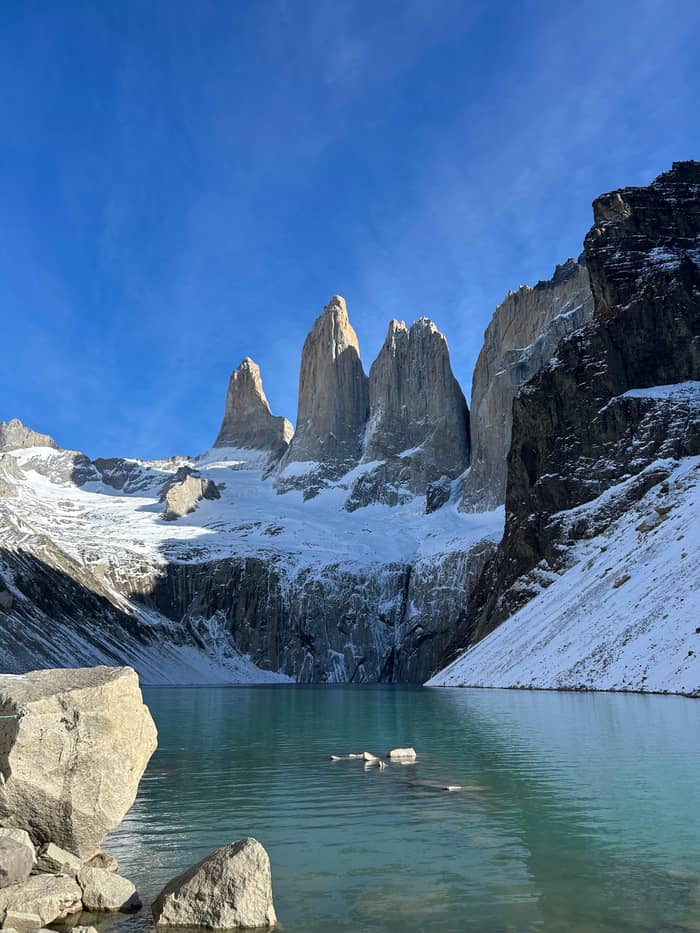
Site tour
Our guided day
Guide in English and Spanish
- Length15 hours
- TrekAdvanced
- InsuranceRequired
Deciding made easy
Base of the Towers day hike from Puerto Natales
★ 4.8 · 878 written reviews
Two questions about your legs
Answer two questions about your fitness and the support you want, and a fitting day appears with its starting price.
The right fit for you
from $99
An advanced trek of 22 km with a guide in English or Spanish, pickup included.
The right fit for you
from $109
A group of up to 12 on a trek the listing rates medium-high intensity over 20 km.
The right fit for you
from $150
Trekking poles and ice crampons included when needed; a high fitness level is asked for.
The right fit for you
from $75
12 hours of viewpoints with only short walks, the towers seen from Laguna Amarga.
What the park authority and the trail operator say about the climb, where it bites, who struggles and how to prepare your legs and knees in the weeks before.
Editorial team, baseofthetowershike.com · Updated November 12, 2026 · Takes 6 min
Essentials
Ask about Base Torres hike difficulty and you get a remarkably consistent answer from official sources. CONAF, the park authority, rates the trail medium to high and estimates 8 hours there and back.1 Its bulletin for this season calls it moderate to strenuous and advises medical clearance before you arrive.3
Las Torres Patagonia, on whose land the trail starts, grades it moderately high and allows around eight hours for the round trip if you keep your breaks short, with a highest point of 850 meters above sea level.4 Chile's tourism service goes further and calls it a highly demanding hike of 8 to 10 hours.5
The listings say the same in their own words. Our day describes the trek as advanced, with inclines and uneven terrain. A small-group operator calls it medium-high intensity over 20 km, and another day with transfer asks for a high fitness level. Nobody who knows the trail calls it easy, and you should not plan it as an easy day.
Section by section
| Section | Length | Time | Summer | Winter |
|---|---|---|---|---|
| Hotel to Chileno | 5 km | 2 hours | Medium | Difficult |
| Chileno to ranger post | 3 km | 90 minutes | Medium | Difficult |
| Ranger post to lookout | 1.4 km | 1 hour | Demanding | Difficult |
One way, as CONAF lists each section; the return uses the same path.7,10,2
The trail starts gently from the bridge over the Ascencio River beside Hotel Las Torres, then turns up the slopes of Almirante Nieto into the Ascencio valley.6,8 CONAF rates this stretch to the Chileno refuge as medium: 5 km in about 2 hours, but difficult in winter.7 The climb comes early, while your legs are still cold.
Partway up the valley the path narrows at Paso de los Vientos, a ledge where the wind greets you, as Las Torres Patagonia puts it, with a Patagonian welcome.8 On a still morning it is a scenic corner; on a windy day it is the place where you lean into the slope, shorten your stride and keep your poles on the uphill side.
Pacing here decides the day. Walkers who rush the first hour tend to pay for it on the moraine later in the day, so treat the valley as a warm-up. Breathe through your nose, keep talking to your companions, and if you cannot hold a conversation, slow down. There is a long way still to go, and almost all of it is uphill.
The Chileno refuge is the natural halfway break, a place to rest and swap stories with other hikers before entering the lenga forest.15 It is also the last settlement before the final ascent, so whatever you need, water, food or a toilet, take it there.9 CONAF rates the next 3 km to the Torres ranger post as medium, about 90 minutes.10
The forest is the gentler interlude, with shade and softer ground. Then comes La Morrena. CONAF rates the final 1.4 km to the lookout as demanding, about 1 hour, and warns that the glacial moraine can injure leg joints.2 Las Torres Patagonia calls it the last and most challenging part of the walk.15
The moraine is a steep field of boulders without shade from the sun, so reapply sunscreen on clear days.16 A small-group operator notes that the last half hour goes slowly over the stones. Use your hands on the big steps, place each foot deliberately, and let faster walkers pass where the path widens.
Support on the climb
Site tour
Guide in English and Spanish
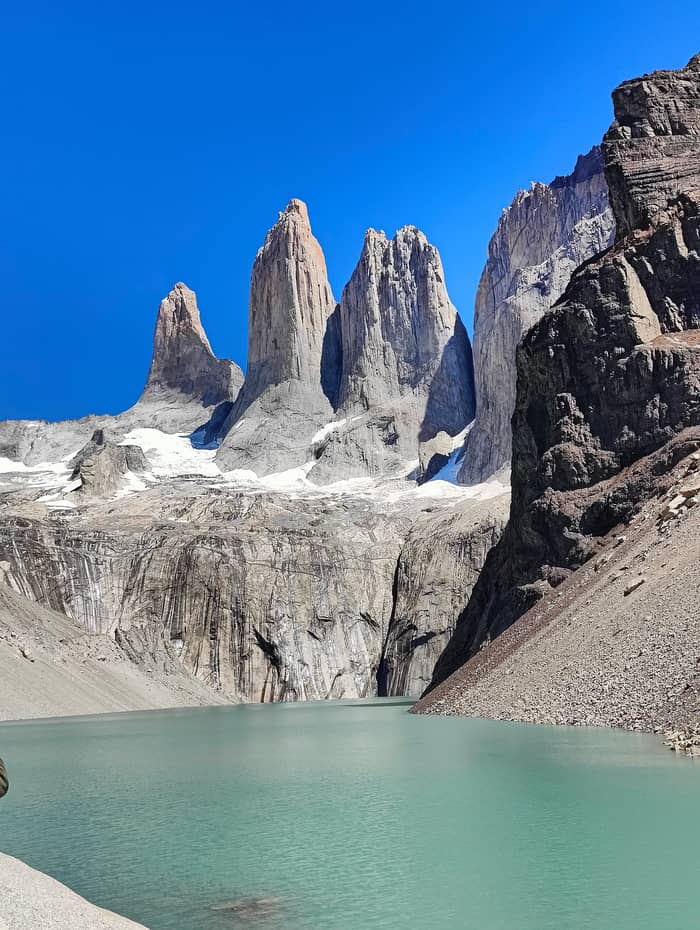
Small group
Up to 12 walkers
Gear included
Gear for icy days
Wind is part of the difficulty here. By Las Torres Patagonia's account it runs from a steady 20 km/h to gusts that hit 110 km/h, and the summer months blow hardest.11 In December, its blog notes, gusts can reach 70 km/h or more.12 A gust on the narrow pass or the open moraine can push a light walker off balance.
The weather can turn in minutes. CONAF reminds walkers that Patagonian weather changes fast, that layers must handle rain, wind and snow, and that overestimating yourself or underestimating nature can be dangerous.17 After heavy rain or thaw, streams rise, and you should not cross if the water is above your knees.18
Then there is the way down, which many people underestimate. You descend the same path you climbed, about 4 hours on average, on tired legs and often in afternoon wind.19 Downhill steps on loose stones are where knees ache and ankles turn, so keep your concentration until you see the hotel roof again.
Effort along the trail
Start
The trail crosses the Ascencio River near Hotel Las Torres.6
First climb
CONAF gives 5 km and about 2 hours to Chileno.7
Windy pass
A narrow stretch where the wind hits hard.8
Halfway
The last settlement before the final ascent.9
Forest
A further 3 km, about 90 minutes, through the trees.10
Final hour
A demanding 1.4 km over boulders to the lookout.2
Base of the Towers hike difficulty has less to do with altitude than with long hours on rough ground. The people who find this day hardest are not always the least fit. Long-legged runners can suffer on the boulder steps, and gym-goers who never walk downhill can finish with burning thighs. The day asks for endurance across many hours, steady footing on rock, and knees that tolerate a long descent, so train for exactly that.
Las Torres Patagonia suggests a simple test: walk a 10 km local trail and notice how your knees handle elevation gain and descent, how your breathing changes and how you recover.13 In the weeks before, add shorter walks during the week and longer weekend hikes of 15 to 20 km if you can.20 Hills matter more than flat distance.
Carry a loaded daypack on those training walks, wear the boots you will use in Patagonia, and include stairs or steep slopes for the descent muscles. If a long hilly walk leaves you sore for days, consider a slower pace on the day, a guided group, or the ride on horseback to Chileno that Las Torres Patagonia offers to save energy for the moraine.14
Video
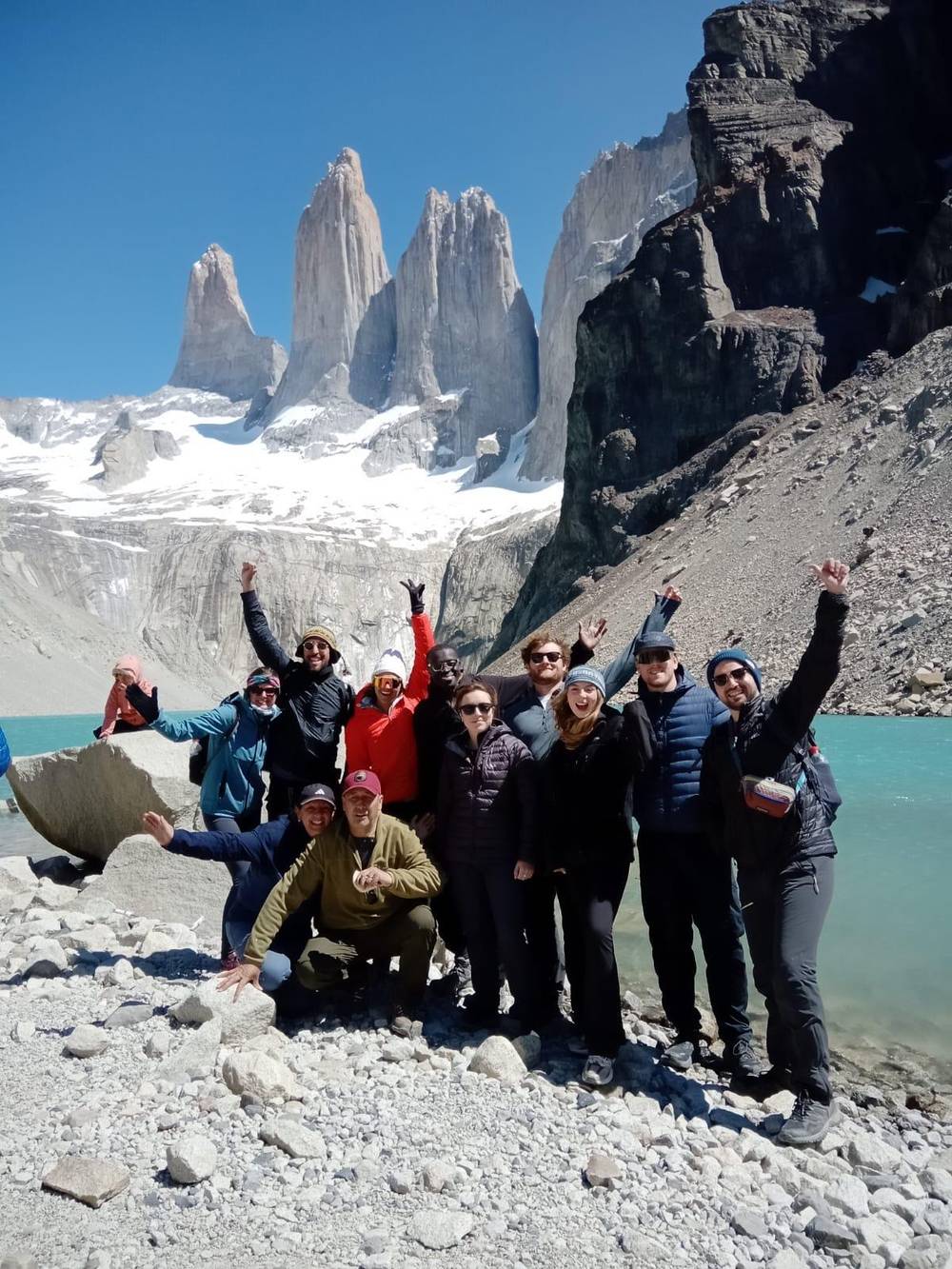
Jordan Every Day on YouTube · The video only starts loading on your tap.
Get ready
Poles are not optional extras on this trail. On CONAF's park page, poles and microspikes are still a safety requirement, while the season bulletin strongly recommends poles alongside proper mountain boots.21,3 They spread the load on the descent and steady you on the moraine. Las Torres Patagonia notes that poles can be rented in Puerto Natales.22
For older walkers and children the official advice is cautious. CONAF's bulletin does not recommend the trail for young children or elderly hikers.3 Las Torres Patagonia suggests asking your doctor whether a child should walk the distance you plan.23 CONAF also asks parents never to leave children alone on the trails or lose sight of them.24
Whatever your age, fitness, balance and knee health decide how the day goes, and the park's advice above still stands. Be honest with yourself, and remember that our day requires travel and medical insurance, which tells you how seriously its operator takes the risk.
Turning back is part of good mountain sense, not a failure, and the park builds it into the rules of the trail. CONAF's 2026-2027 bulletin sets closing times for leaving the lookout, from 14:00 in September to 16:00 from December to February, so walkers are off the mountain before dark.25,26 Only the sector ranger can allow walking after those hours.26
Keep to the waymarked route; CONAF's safety advice ties the park's deaths almost entirely to walkers who left it.27 In an emergency the reserve's staff respond first and then CONAF runs the evacuation.28 The nearest medical center is in Puerto Natales, and CONAF lists the hospital there as 80 to 140 km from the park.29,30
Weather can also close the trail for everyone. On 10 November 2026 CONAF kept the Mirador Base Torres trail shut for a warning of wind gusts, rain and storms, and expected to open it again on 12 November.31 A closed trail is frustrating, but the rangers close it on the days when the climb would be truly dangerous.
FAQ
CONAF grades the final 1.4 km, over the moraine, as demanding and warns of leg joint injuries.2
The trail's operator suggests a guide for anyone new to mountain walking.32
Gusts can hit 110 km/h, and summer is the windiest time, according to the trail operator.11
Sources
Related guides
Planning the Base Torres day? Ask a real person.