Daylight only
Guided day hike
From Puerto Natales
- Pickup6:15 to 6:45
- Drive2 hours each way
- Pricefrom $99
Estimate your group cost
Base of the Towers day hike from Puerto Natales
★ 4.8 · 878 written reviews
Answer in brief
A true sunrise at the Base Torres lookout is very hard to plan today: CONAF bans hiking without daylight and the Torres campsite below the moraine is permanently closed, so the earliest light comes from a night at Refugio Chileno.
Know first
Compare 3 side by side
Compare guided days and add the number of hikers.
≈
View≈
View≈
ViewGetYourGuide's starting prices, converted at the ECB reference rate; exact pricing appears when you book.
A Base Torres hike sunrise is the photo everyone knows. Here is what the park's rules allow today, where you can sleep closest to the towers and what a day hiker sees instead.
Editorial team, baseofthetowershike.com · Updated November 12, 2026 · Takes 9 min
Essentials
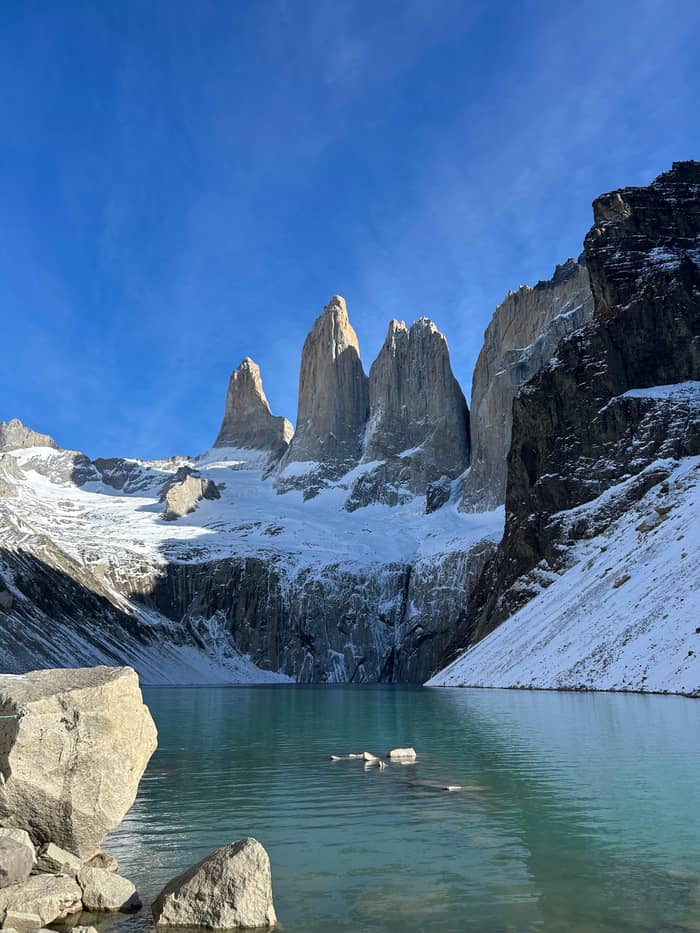
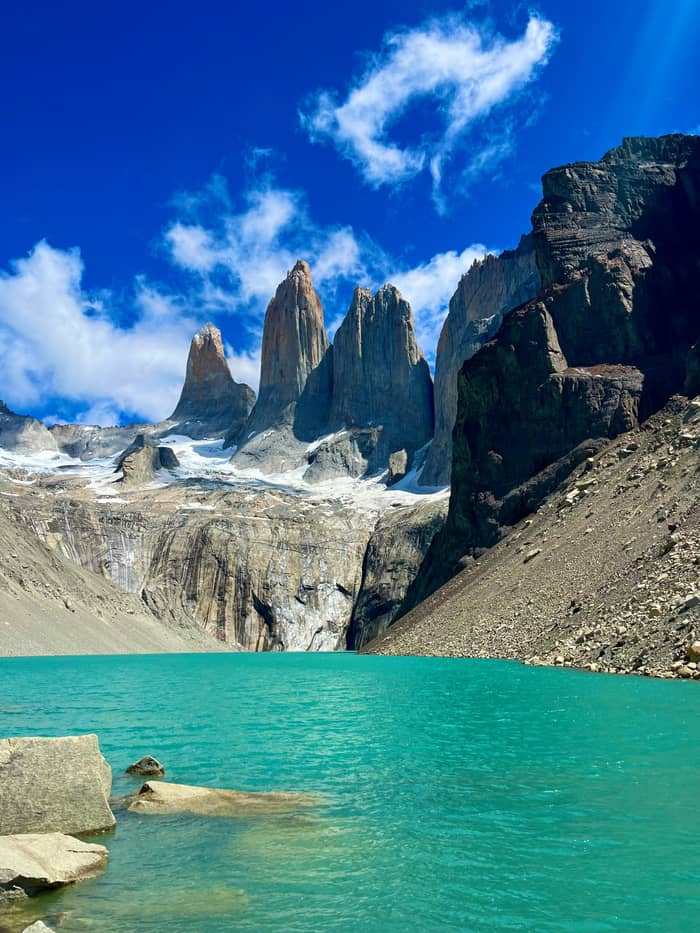
The image that sells the Base Torres hike sunrise is real. Chile's tourism board describes dawn as the peak moment for many visitors, when the earliest sunlight colours the granite needles a deep, intense red.1 It is the face of the towers that looks east, toward the lagoon and the valley you climb, that catches that first light. From the lookout you face that wall almost head on, and the photographs from the lagoon show the whole cirque glowing at once.
The colour comes from low sun on pale rock. When the sun sits just above the horizon its light passes through more air, loses the blue end of the spectrum and arrives warm, and bare granite reflects that warmth back almost unfiltered. Higher in the morning the light turns white again, and the towers return to their grey and cream. The effect is brief on a clear morning, and the colour drains from the rock as the sun climbs higher over the steppe.
Sernatur's own guide to the country's great heights calls standing before the towers at sunrise, when the light turns them pink, an unforgettable moment.6 Whether you see pink, orange or deep red depends on cloud. A clear eastern horizon gives the strongest colour; a band of cloud low in the east can switch the show off even when the towers themselves are clear. That is the gamble of any dawn plan here: you can do everything right and still watch the sun rise behind a grey bank.
Ways to the morning light
| Option | Walk to the lookout | Light you get | Season |
|---|---|---|---|
| Day hike from Natales | From the hotel, about 4 hours15 | Midday to early afternoon | September to April16 |
| Night at Refugio Chileno | 90 minutes plus 1 hour4,5 | Early morning | October to late April17 |
| Camp near the hotel | About 4 hours from the hotel area15 | Morning | From mid-September18 |
Times per CONAF and Las Torres; opening dates per the park's season bulletin.4,15,17
This is the part most sunrise guides skip. CONAF, the agency that runs Torres del Paine, prohibits walking the park's trails without daylight.2 Chile's tourism board repeats the same advice for every visitor: hike only during daylight hours, along the marked trails.10 A sunrise at the lookout means arriving there before the sun is up, which puts the approach in the dark. The moraine section is steep, loose in places and hard to follow without light, and that is exactly the stretch a sunrise plan would put in the dark.
CONAF explains why the rule exists. Walking in the half-dark is dangerous, it says, because you can get lost, fall or be attacked by a puma.11 It adds that wildlife is more active at night and that people walking with torches change its behaviour.12 Wildlife watching and photography are also allowed only in daylight and only from the official trails.13 The rule is not a formality, and the park rangers on duty are the people who apply it on the day.
Las Torres Patagonia, which runs the reserve and refuge on the lower trail, gives the same advice from its side. Its advice is to wait for sunrise before setting out, and it points out that no rangers patrol the trails before 8:00.14 Anyone planning a Mirador Base Las Torres sunrise hike should read them first. Read together, these rules leave little room for a night climb up the moraine to wait for the sun. If you see older advice describing a midnight start, treat it as out of date for the current season.
A dawn plan needs a bed close to the moraine, and the closest bed is gone. In the current season bulletin, the park marks its own Torres, Paso and Italiano campsites as closed for good.3 With Torres closed, the nearest beds below the lookout are in the Chileno area, further down the valley. That change reshapes any sunrise plan at Base Torres, and it is the first thing to know before you book a bed.
From Refugio Chileno the walk is longer than the camp ever was. CONAF lists 3 km and 90 minutes from Chileno to the Torres ranger post, then 1.4 km and 1 hour to the lookout.4,5 That puts the lookout 90 minutes plus 1 hour of steady walking above the refuge, the last part on the steep, rocky moraine that CONAF warns about.4,5,19 Even fit hikers move slowly there, and the rocks are much harder to read in poor light.
The closing times point the same way. On the official map, the upper sections above Chileno close at 18:00 in summer, though this season's bulletin closes the lookout earlier, at 16:00 from December to February, and the park explains its closing hours as a guard against hikers being caught out by nightfall.20,9,21 The park plans the day around light at both ends, and so should you. Building your plan around daylight is not only safer but also gentler on the rest of your trip.
Dawn or daylight?
Your goal at the lookout decides the plan.
If I want the red sunrise photograph
Ask the rangers first
CONAF bans walking without daylight, and the old camp below the moraine is permanently closed.2,3
If I want early, soft light and fewer people
A night at Refugio Chileno
Chileno sits 90 minutes plus 1 hour below the lookout on CONAF's table.4,5
If I want the towers without a refuge booking
The guided day hike
Pickup in Puerto Natales, a guide on the trail and free cancellation up to 24 hours ahead.
If I am visiting in September
A day hike or hotel-area camp
Chileno opens on 1 October; the Las Torres camp sites open on 15 September.17,18
Compare the mornings
Daylight only
From Puerto Natales
Early light
Refuge in the Ascencio valley
Book the day hike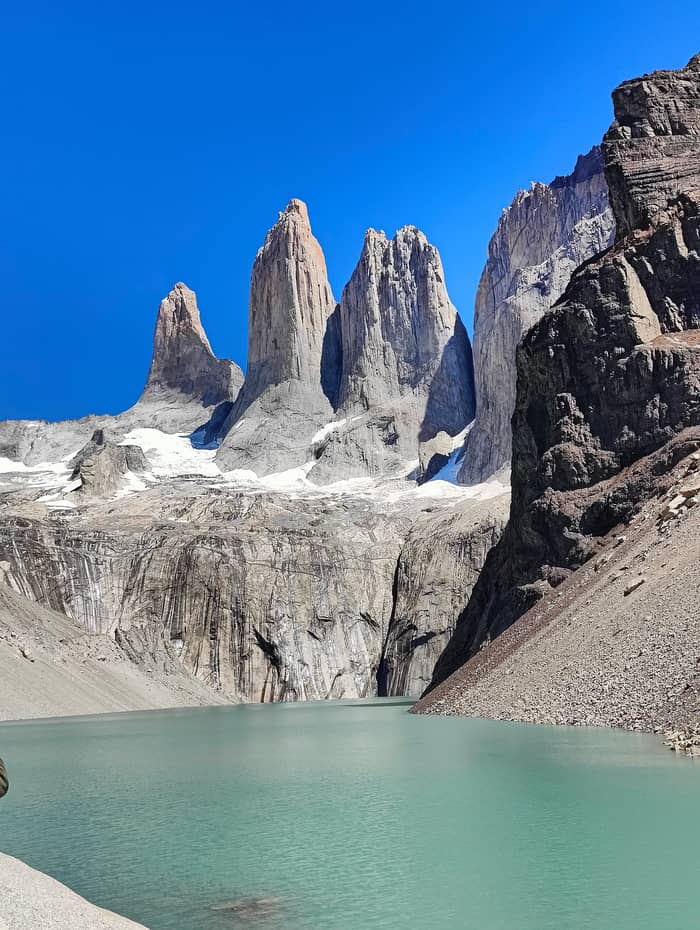
Morning start
Las Torres camp sites
Book the day hikeIf dawn colour matters to you, Refugio Chileno is the closest legal base when you want a Torres del Paine base towers hike at sunrise. Chileno, a Las Torres refuge, takes guests between 1 October 2026 and 25 April 2027 according to the bulletin, while the Las Torres campsites open from 15 September 2026.17,18 Book early in the season, as a refuge has a fixed number of beds and a popular trail fills them. Check what is included, such as meals or bedding, when you book, so the pack you carry up stays light.
A night at Chileno changes what the morning can be. You start the climb at first light instead of after the drive from Puerto Natales, you reach the lookout ahead of the groups driving in from town, and the low morning sun still rakes across the granite. It will not be the red moment of sunrise itself, but it is the softest light the rules allow on the moraine. You also get the quiet: the lagoon early in the day is a different place from the busy lookout of midday.
Ask at the refuge and at the ranger post about the earliest permitted start on your date. The rangers decide trail access day by day, and the park bulletin says access may close without notice in high wind.8 Las Torres recommends one headlamp per person, for use only after dark around the refuge.22 Pack it anyway, along with a warm hat, since mornings in the valley start cold even in summer.
An overnight at Chileno
Afternoon before
The walk up from the hotel covers 5 km in about 2 hours.7
Evening
Ask about trail status; rangers can close access for wind.8
First light
Start once there is daylight on the trail, as CONAF requires.2
Ranger post
A 3 km climb under the trees, about 90 minutes.4
Lookout
The last 1.4 km take 1 hour on steep, rocky ground.5
Descent
Leave the lookout by 16:00 at the latest in midsummer, per this season's bulletin.9
Sunrise moves a lot across the hiking season. Las Torres gives sunrise at about 7:30 in the morning from mid-September, and about 12 hours of daylight from October; around the December solstice its blog counts about 17 hours.27,28,29 In midsummer the sun rises very early, and in the shoulder months it rises later and lower. The difference matters if you plan an overnight, since it changes how long you wait at the refuge for light.
Late in the season the timing works in your favour. In March and April the sun rises later in the morning, so first light on the trail and a reasonable breakfast fit together more easily. Early in the spring the same is true, with the extra chance of fresh snow on the peaks to catch the colour. Midsummer mornings, by contrast, come so early that the colour can arrive before most people are out of their sleeping bags.
For an exact time on your date, use a sunrise calculator set to Torres del Paine and remember that the lookout faces the towers from the east, where the valley walls can hide the sun for a while after it has risen over the plain. Light reaches the summits first and the lagoon last. Give yourself time at the lookout rather than a fixed minute, as the colour comes and goes with passing cloud.
Video
Gio's Postcards on YouTube · The video only starts loading on your tap.
However, the peak moment for many visitors occurs at dawn, when the first rays of sun dye the three granite needles with an intense reddish hue, revealing the most iconic and breathtaking image of Chilean Patagonia.
Early light kit
The guided day hike is built for daylight. Pickup in Puerto Natales falls between 6:15 and 6:45, the drive takes 2 hours each way, and the itinerary allows 8 hours of hiking in the park. By the time you leave the van, the sun has long been up, and you reach the lookout around midday or in the early afternoon. The towers then stand in flat, bright light, which shows the texture of the granite and the colour of the water well.
That light is not a consolation prize. With the sun higher, the lagoon below the towers turns its full turquoise, and Sernatur promises the walk itself near-constant company from Mount Almirante Nieto and passing condors.30 Midday also gives the best chance of a warm hour on the rocks before the descent. Bring a warm layer for the stop, as the wind across the lagoon cools you quickly once you sit down.
Prices for the day hike begin from $99, with pickup at your Natales lodging included. If dawn is not essential to you, it gets you to the towers with the least planning, without booking a refuge bed, and it brings a guide who reads the wind and the trail for you on the day. Cancelling stays free until 24 hours before; a stormy forecast can then move your date rather than wreck it. It is the low-stress way to stand at the lagoon.
Start by deciding what you want from the lookout. If it is the red photograph, accept that the park's daylight rule and the closed campsite make a true sunrise at the lagoon very hard to plan, and aim instead for early light from a night at Chileno.2,3 If it is the towers and the lagoon themselves, a day hike gives you both. Be honest with yourself about which of those goals you are really travelling for.
Think about effort as well. A night at the refuge splits the climb and lets you walk the moraine fresh, while the day hike packs the whole route into a single long day of about 22 kilometers.15 Neither is easy; the park rates the last section to the lookout demanding in summer and difficult in winter.5 Split or not, the moraine is the same climb, and the legs you bring to it decide how much you enjoy the top.
Finally, check the season. Chileno is open from October to late April, so an overnight is only possible inside that window, while the park's bulletin season for hikers runs from September to April.17,16 Whichever you choose, give yourself a spare day for wind. A plan with slack in it is the plan most likely to end with the towers in view. Whichever morning you choose, the walk out through the valley in the afternoon light is a fine reward of its own.
FAQ
Chile's tourism board describes the first rays dyeing the granite needles an intense reddish hue at dawn.1
The refuge in the Ascencio valley welcomes guests from 1 October 2026 through 25 April 2027.17
CONAF's campsite at Torres, along with Paso and Italiano, is listed as permanently shut in the season bulletin.3
The listing picks you up between 6:15 and 6:45 and drives 2 hours to the park.
Las Torres says one headlamp per person is enough, used only after dark.22
Sources
Related guides
Planning the Base Torres day? Ask a real person.